Algal diversity
The term algae is used to collectively refer to a wide range of simple, aquatic, photosynthetic, oxygen-generating organisms. Over 50,000 species of algae are recognised (Guiry, 2024) and these are listed in the online algal database Algaebase. We refer to algae we can see with the naked eye as macroalgae while those we need a microscope to see we call microalgae. Previously, the term Algae was an accepted taxonomic group with various subsections based largely on their photosynthetic pigments. Although the umbrella term Algae covers several distinct lineages and is no longer an accepted taxonomic term it is still a useful informal term. Blue-green algae or cyanobacteria even though these are prokaryotes are still considered algae even though all other algal groups are eukaryotic. Note that in the Caribbean seaweeds are often confusingly referred to as “moss” which botanically is a term used for a group of Bryophytes not algae!
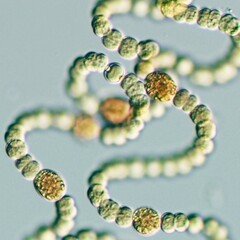
© Glen McGregor CC BY-NC
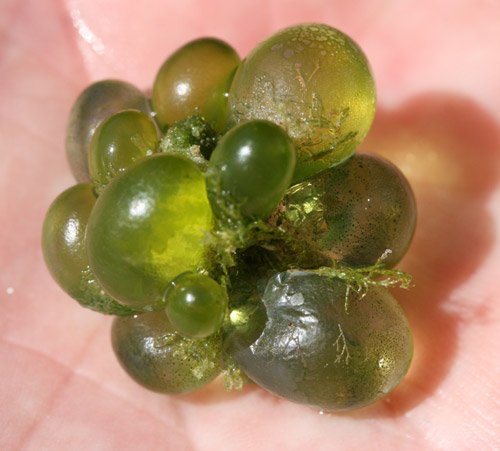
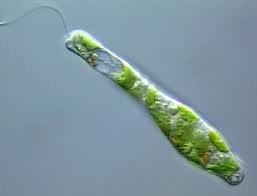
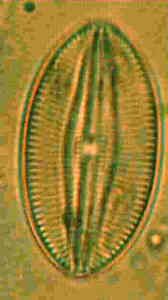
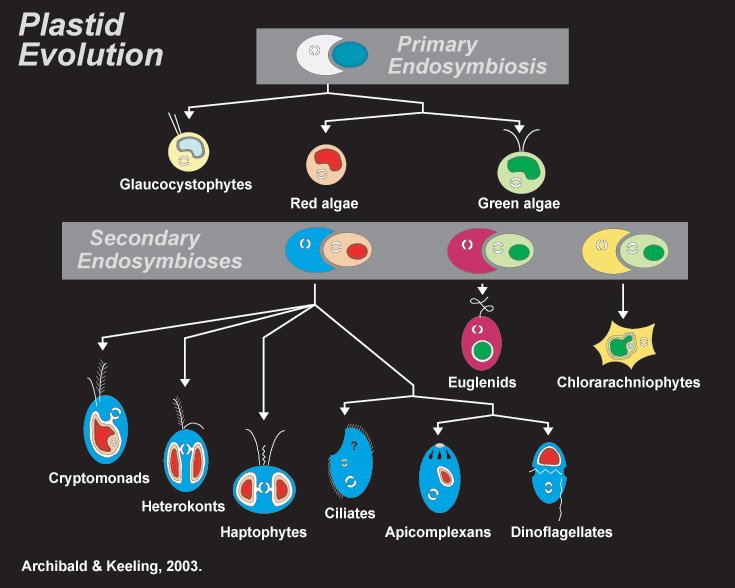
The first plants evolved from a primary endosymbiosis with a photosynthetic prokaryote being engulfed by an aerobic eukaryote. From this initial event, two major plant lines evolved – the green algae and the red algae. The green algal branch went on to colonize terrestrial ecosystems, giving rise to land plants. The “red” line would dominate photosynthesis in the oceans, both in terms of the red algae and the organisms which derived their chloroplasts from this “red” branch. After this primary endosymbiotic union, secondary and even tertiary endosymbioses occurred – algal cells themselves getting engulfed to give rise to other algal groups (e.g. euglenids, brown algae, diatoms, dinoglagellates).
Click here for another figure showing algal evolution from Delwiche (1999) Tracing the web of plastid diversity through the tapestry of life. American Naturalist 154:S164-S177.
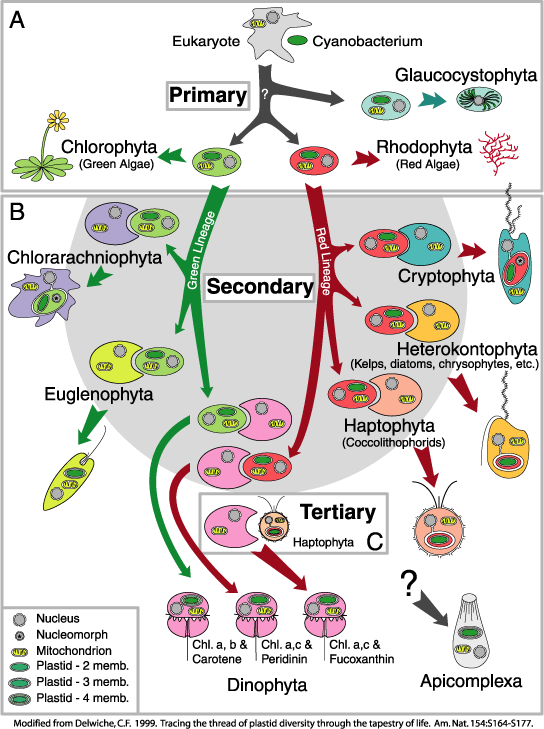
In this course we will consider the Plant Kingdom as comprising the green lineage from green algae to terrestrial plants. Some term this clade the Viridiplantae (lit. green plants) to distinguish it from the Archaeplastida a broader definition of the plant kingdom that includes all organisms part of that original primary endosymbiosis that includes the red algae.
Green algae
The number of green algae species approaches 12,000 (Guiry, 2024), comprising two major groups, the Chlorophytes and the Charophytes. Green algae vary greatly in morphology including unicells, colonies, filaments, and various marcoalgae.
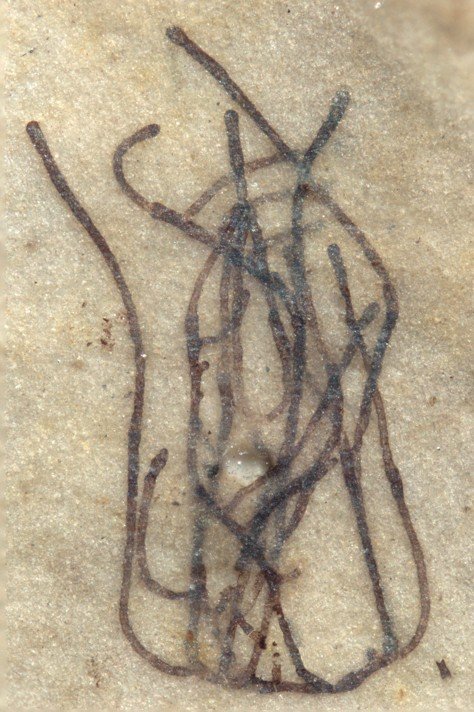
The earliest multicellular green alga known is the fossil alga Proterocladus antiquus, found in rocks 1,000 million year old in Northern China.
Photo by Drs. Qing Tang & Shuhai Xiao
Key Algal Features
There are 3 features which distinguish algae from land plants;-
Body plan: There is no specialisation of the algal body into root, stem etc. The photosynthetic portion of macroalgae is a thallus while the attachment portion comprises hair-like rhizoids. For this reason, old classification systems put the algae into a grouping known as the Thallophytes.
No Embryo: For most algae, sperm and eggs fuse in the open water and the zygote develops into a new plant without any protection. For other plant groups the zygote develops into an embryo within the protection of the parent plant. For this reason, all other plant groups are termed Embryophytes.
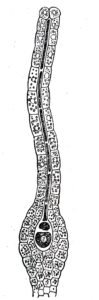
Reproductive structures: In algae, the gametes are produced within a single cell. There is no jacket of sterile cells protecting the gametes as in land plants.
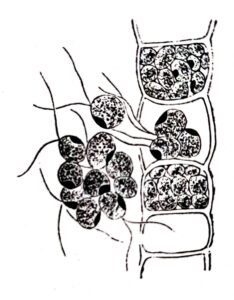
[Strasburger et al. (1908) p258].
Where algae live
Being aquatic, algae are
- marine
- freshwater
- terrestrial
Within the aquatic environment, there are two broad niches, the planktonic and the benthic.
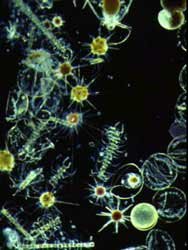
Planktonic algae are floating algae. For micro-algae these often have strange shapes which help keep them suspended and deter predators.
Benthic algae are attached algae. These are algae anchored to the substratum.
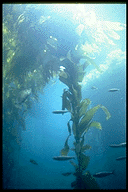
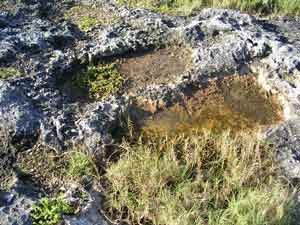
Terrestrial algae are effectively surviving in an aquatic environment on land. Soil algae survive in a film of soil water. On land, algae are often pioneer organisms, growing on bare rock (provided there is moisture). The rock weathers and crumbles, the algae die and the remains of both contribute to formation of soil. This pioneering activity paves the way for more demanding plants to invade. A succession such as this is precisely what would have occurred when the islands of the Caribbean first emerged from the sea and still happens to this day on seaside cliffs.
A major group of terrestrial algae are those in lichen symbioses. We have known for a long time that lichens comprise fungi together with algae or cyanobacteria in partnership. The fungus provides an outer weft of mycelia which creates a humid protected environment for the alga to live and photosynthesise and feed the fungus. In 2016, it was discovered that a third symbiotic partner, a yeast, may be present in lichens altering the character and appearance of the lichen.
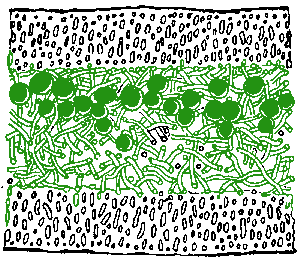
[from Strasburger et al. (1908), p417].
Lichens have distinctive morphologies and so these associations have traditionally been given genus & species names as if they were single discrete organisms. Three major growth forms are recognised;- crustose forming a crust-like layer on a rock or tree trunk, foliose forming a flat, leafy, lobed structure and fruticose forming a three-dimensional shrub-like or hair-like structure.
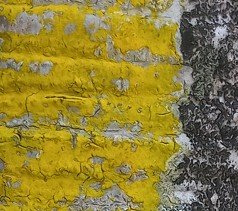
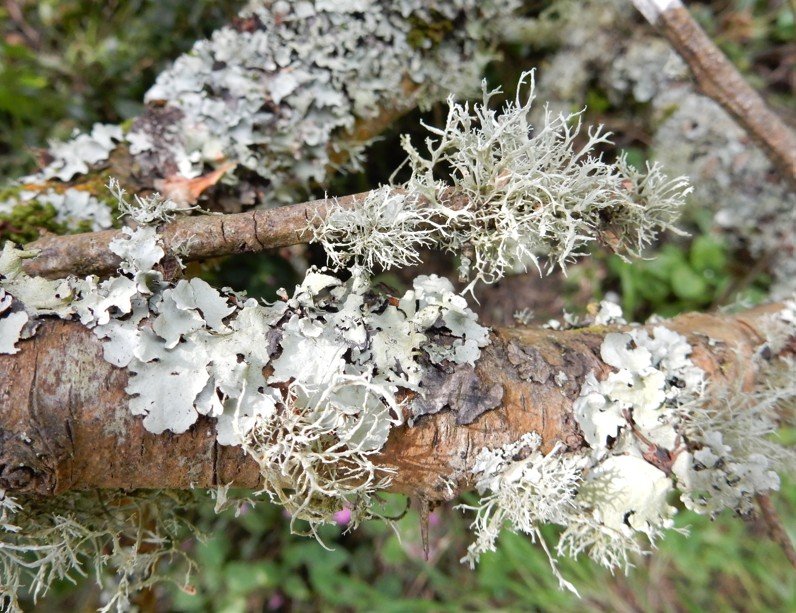
Lichens are very good sensors of environmental pollution. They absorb chemicals from the air and so serve as bioindicators of pollution. If you see lichens in your neighbourhood growing on rocks, tree trunks and utility poles that suggests that you have good air quality.
Economic Significance of Algae
- Algae are primary producers, i.e. they are the start of the food chain, fixing carbon dioxide. Phytoplankton are responsible for almost half of the Earth’s annual primary production.
- Algae – “oilgae”- are seen as a source of third generation biofuels.
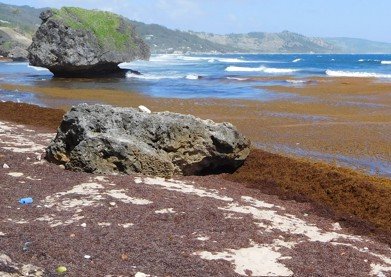
- Algae under particular nutrient-rich conditions may grow disproportionately causing potentially harmful algal blooms, like that caused in the Caribbean by the brown alga Sargassum.
- Seaweeds are used as fertilisers and even food (by the Japanese, Irish, Welsh and even some of us here in the Caribbean who enjoy “sea moss” ).
- Extracts from the cell walls of algae (typically brown & red, though!) provide the polysaccharides agar and carageenan. These are used as thickening agents in food, in surgical dressings and in microbial media.
- Algae are essential for corals to build reefs. Corals contain microscopic algae in a mutualistic relationship which fix carbon dioxide to provide a fuel source for the animals that build the coral reef. Secondly, the exoskeletons of coralline macro-algae often become incorporated into a reef after the alga dies.
- The skeletons of one group of algae (the diatoms – not green algae!) are glass-like and this material (diatomaceous earth) is put to a variety of uses, such as abrasives (once used in toothpaste), insecticides, reflective road signs, swimming pool filters.
Algal Morphology
You can just about see the full range of “body types” within the algae by just looking at the green algae.
Unicells
These algae are single cells, with or without flagella.
Non-motile unicell – Chlorella
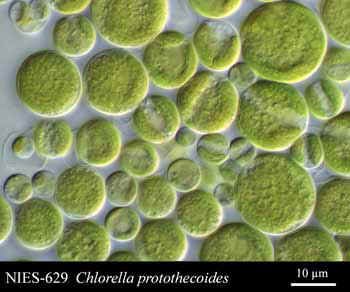
Ankistrodesmus is another example of a non-motile unicell.
Motile unicell – Chlamydomonas
Chlamydomonas is a freshwater, motile unicell, propelled by two whip-like flagella. It has contractile vacuoles near the base of the flagella. Its reddish eyespot is a photosensitive organelle allowing the cell to detect light direction and intensity and respond to it.
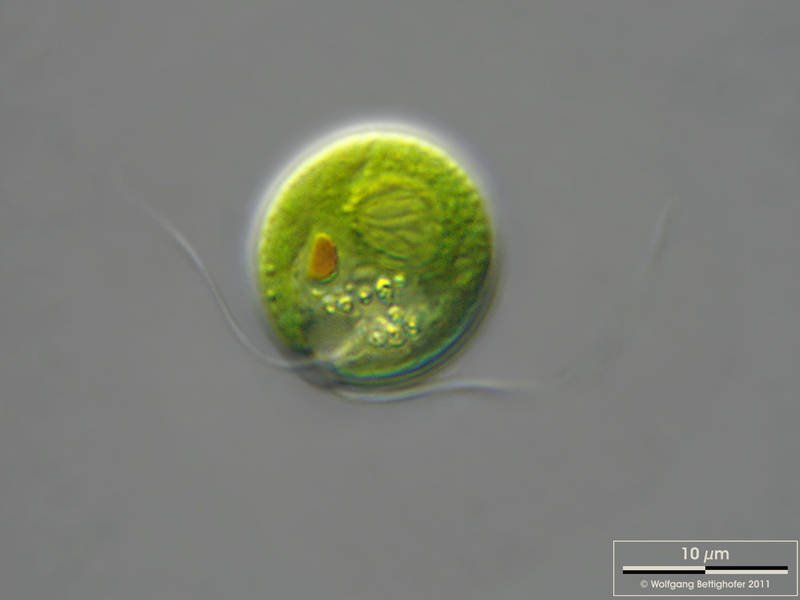
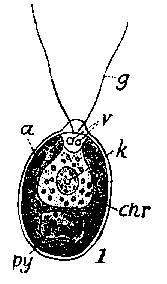
Chloroplast (chr),
Eyespot (a)
Flagellum (g)
Contractile vacuoles (v)
Pyrenoid (py)
[Strasburger et al. (1908) p353]
5 µm diam.
Colonies
Colonies comprise single cells which typically exists as clumps of varying numbers of cells. The key point about colonies is that there is no division of labour and each cell can survive on its own.
Oocystis with its egg-shaped cells in a mucilaginous envelope is an example of a colonial green alga.
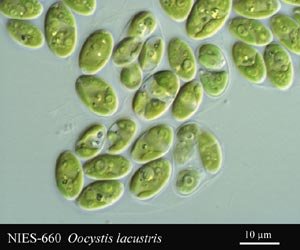
Coenobia
A coenobium (pl. coenobia) is a colony with a fixed number of cells. Coenobia may be motile or non-motile.
Motile coenobium – Volvox
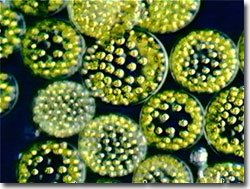
Volvox is an example of a motile coenobium. It comprises a set number of Chlamydomonas-like cells embedded in a hollow, spherical gelatinous matrix.
Non-motile coenobium – Scenedesmus
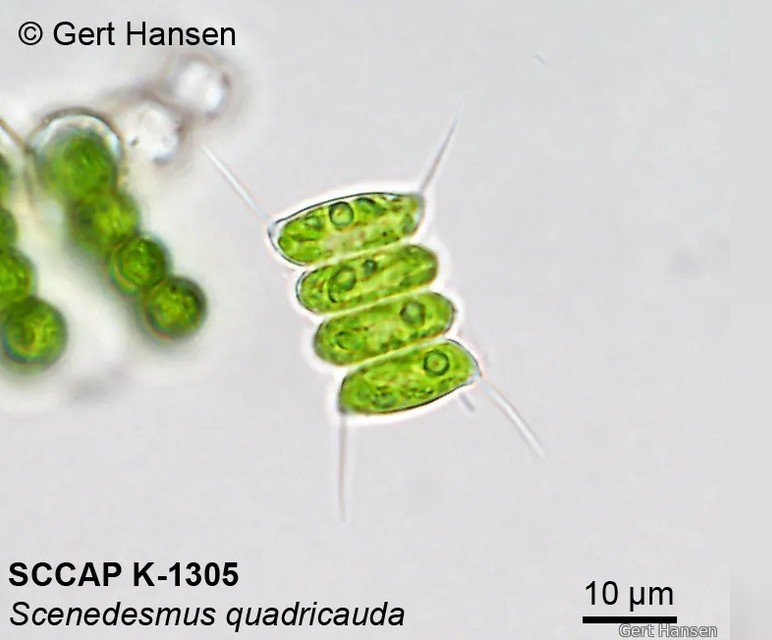
Scenedesmus is an example of a non-motile coenobium. Typically, this coenobium comprises 4 cells. The two end cells have horn-like projections of their walls.
Siphonous algae
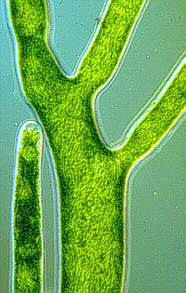
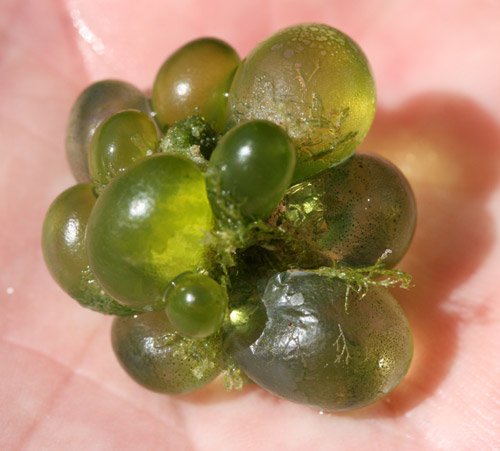
Algae with this body plan are actually giant unicells. These algae are coenocytic which means they undergo repeated nuclear division without the accompanying formation of cell walls. These algae have a tubular structure with the multinuclear cytoplasm lining the thallus (the Greek word for tube is siphon). Two common tropical marine genera are Caulerpa and Bryopsis.
© Peter Sengbusch
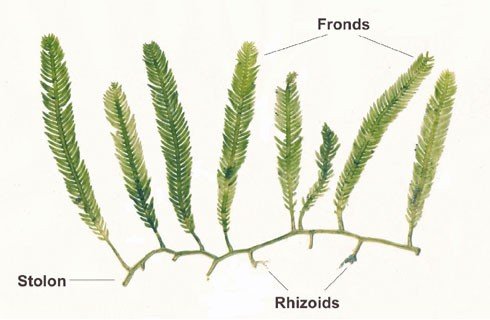
Caulerpa is a siphonous, green marine alga, found in the Caribbean. Despite its simple internal form, it almost looks like a higher plant. It has frond-like assimilators for photosynthesis, a basal runner by which it spreads and rhizoids which fix it to the substratum. Experiments suggest these rhizoids may play a role in uptake of nutrients.
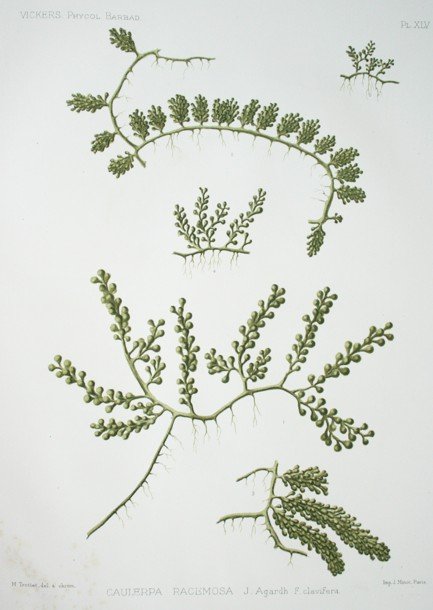
Caulerpa racemosa in Vickers (1908) Phycologia barbadensis.
Scientist Anna Vickers studied marine algae in Barbados in 1898/9 and 1902/3, describing 13 species new to science and creating these beautiful drawings.
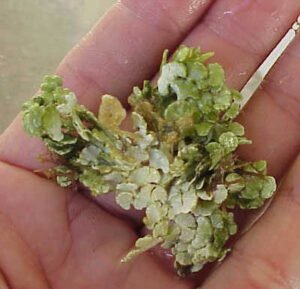
Another siphonous, Caribbean marine alga is Halimeda. This alga is extensively calcified making it more resistant to predation and wave action.
Filamentous algae
Filamentous algae result from cell division in one plane. A good example is Spirogyra where each cell contains a single spiral chloroplast. Although filaments are not normally considered motile, Kim et al. (2005) showed that Spirogyra filaments curl and move toward light, blue light being essential.
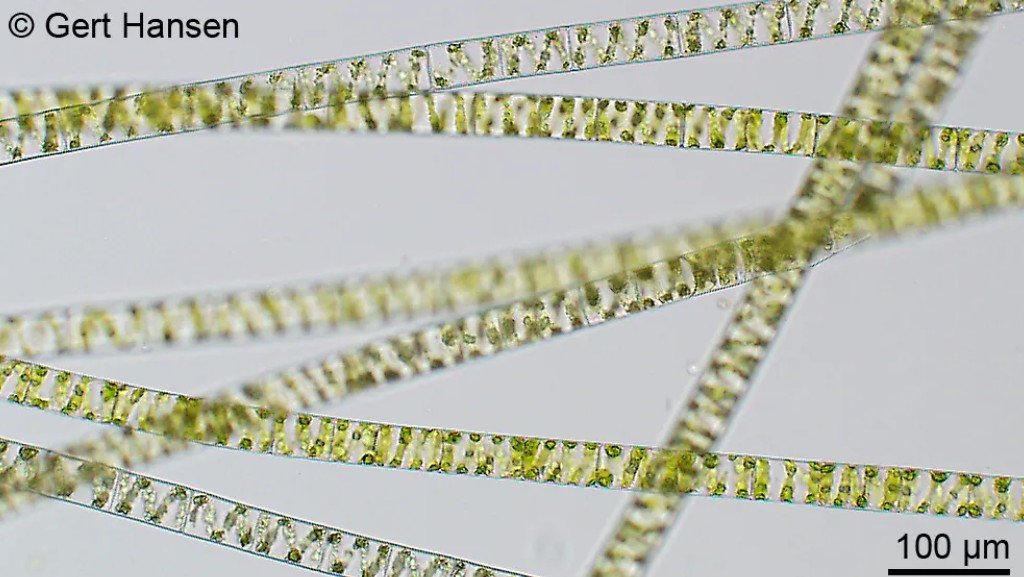
https://nordicmicroalgae.org Creative Commons Attribution-NoDerivs 3.0 Unported
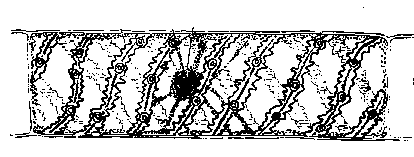
[Strasburger et al., 1908, p347]
There are also algae with branched filaments. Where there are basal, prostrate filaments for attachment and erect branches for photosynthesis, this is said to be a heterotrichous filament.
Pseudoparenchymatous algae
Seaweeds made up of “boxy” cells like those of higher plants are termed parenchymatous. Many red and brown seaweeds are of this type and may be even more complex structurally with stem-like stipes and leaf-like appendages. Others in cross-section appear to be parenchymatous but are, in fact, really made up of interwoven filaments which give this appearance! Several green macroalgae are of this type and are termed pseudoparenchymatous.
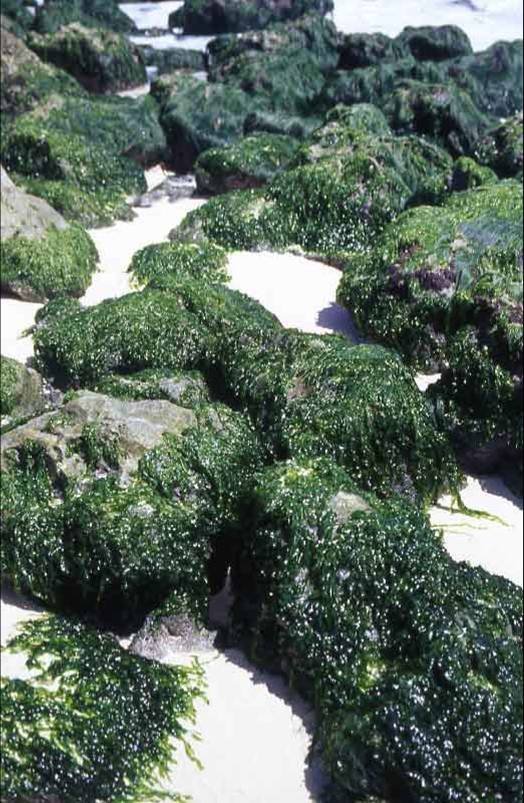
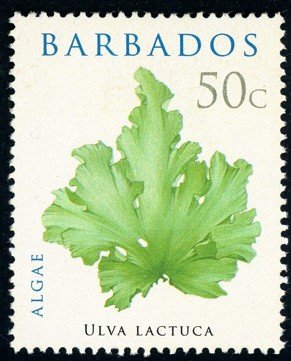
Ulva (sea lettuce) is a membranous sheet with a holdfast for attachment and a pseudoparenchymatous substructure. It grows in shallow sea water, often where there is nutrient-rich run off from the land.
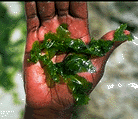
Seaweed morphology has also been classified from an ecological, functional perspective relative to herbivory, wave action etc. In such a scheme, various categories are recognised – sheets, filaments, thick & leathery, jointed & calcareous, crustose, coarsely-branched.
Algal Reproductive Diversity
Algae reproduce asexually by fragmentation and by spores. In the sea, which is such a stable environment, spores are a means of dispersal, not a resting stage.
Sexual reproduction involves the fusion of gametes (syngamy).
In algae three forms are found:
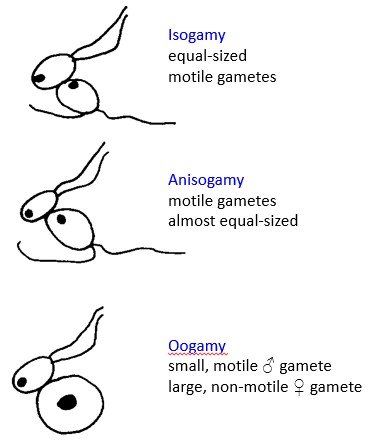
In the simplest algae, all cells can become gametes while in the more specialised algae only some can become gametes.
Algal Life Cycles
Algae normally show alternation of generations. What this means is that there is more than one free-living stage of the organism. Most plants have two recognisable phases – the sporophyte and the gametophyte. The main types of algal life cycles are exhibited by green algae.
Note that Red algae have more complicated life cycles which will not be discussed here.
The sporophyte phase of the life cycle produces spores by MEIOSIS.
The gametophyte phase produces gametes by MITOSIS.
Yes, there are exceptions but this is a rule to remember.
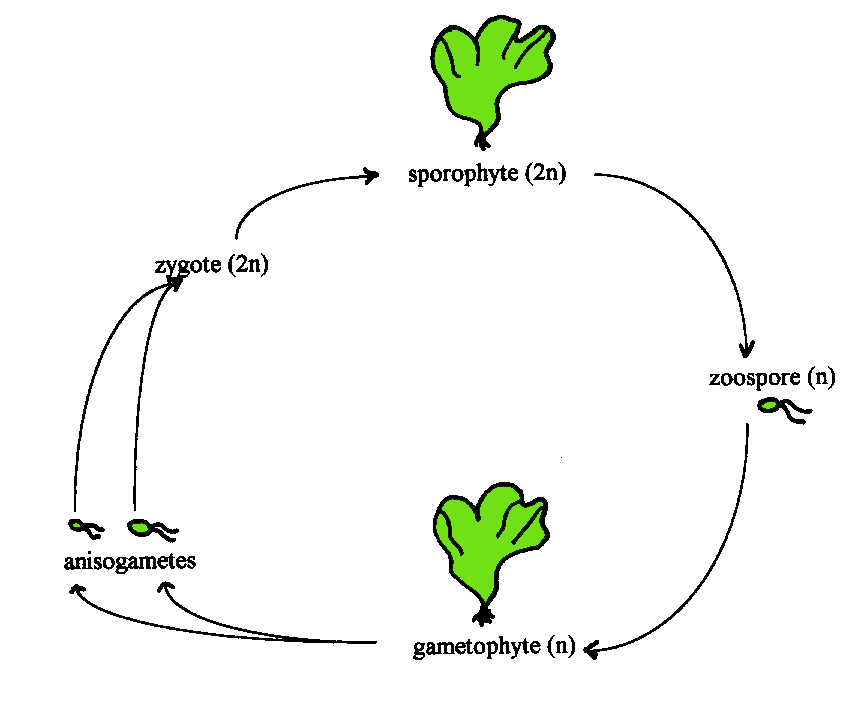
Life Cycle of Ulva lactuca – Sea Lettuce
The diploid sporophyte of Ulva produces motile haploid spores which settle and grow into the next generation, the haploid gametophyte. This produces anisogametes which fuse to form a zygote which grows into the sporophyte generation. The sporophyte and gametophyte generations look exactly alike. For this reason Ulva is said to show isomorphic alternation of generations.
Life cycle of Derbesia
The siphonous green alga Derbesia shows a heteromorphic alternation of generations as the sporophyte and gametophyte look different. The filamentous sporophyte and balloon-like gametophyte are so different they were initially put into two different genera, Derbesia and Halicystis respectively! We now know they are 2 stages of one plant. The shallow-dwelling diploid sporophyte produces multiflagellate spores by meiosis which settle to form the balloon-shaped haploid gametophyte in deeper waters. Gametes are discharged from these which fuse to produce a zygote which forms a filamentous sporophyte.
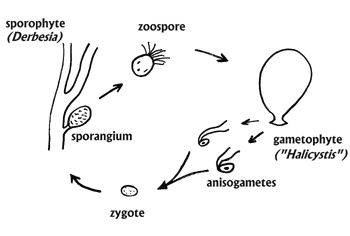
This diagram is an over-simplification as it seems zoospores develop into separate male and female gametophytes which produce the smaller and larger gametes respectively [see Fig. 5.42 in Lee (2008) Phycology, CUP.]
Life cycle of Caulerpa
Caulerpa shows no alternation of generations. Look upon this as an exception to the general pattern found in the plant kingdom. The mature plant is diploid, producing anisogametes by meiosis, which fuse to form a zygote that develops into the mature diploid plant without an intervening haploid stage.
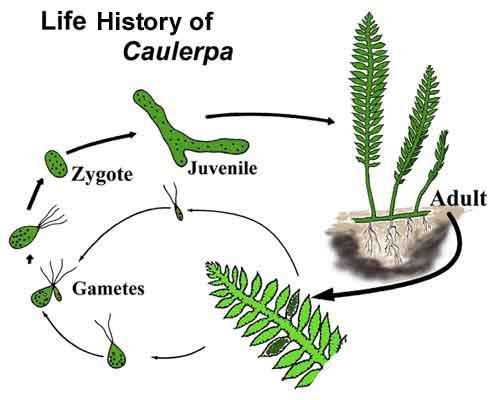
There are two interesting aspects to reproduction in Caulerpa. Firstly, the entire protoplast migrates to the periphery, cleaving into motile gametes and leaving a dead, empty thallus. You can actually see this with the naked eye as the organism turns from green to white!
Secondly, Caulerpa exhibits mass spawning. Since the 1980s it has been known that corals show such synchronized release of gametes. In 1997 Kenneth Clifton reported that Caulerpa also showed synchronized, simultaneous release of vast numbers of male and female gametes. These are released as green clouds into the sea over a 5-15 minute period, typically at dawn.
Charophytes
The Charophytes are the second group of green algae. They are interesting because they share a feature with land plants – multicellular sex organs to protect developing gametes. Not surprisingly, DNA studies also show they are closer to land plants than the major green algal group, the Chlorophytes.
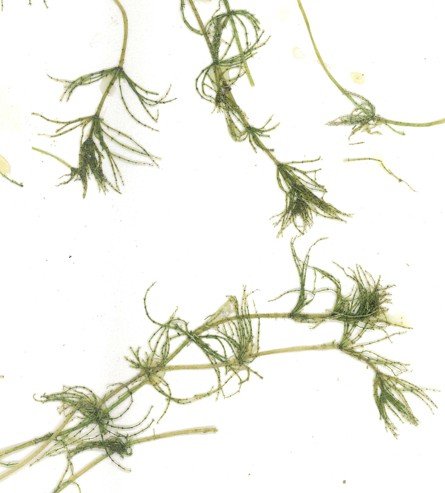
Chara zeylanica grows in ponds and swamps in Barbados. It is a coenocytic macroagla with giant cells, discernible with the naked eye. It is called a stonewort as its cell walls are highly calcified giving it a tough feel.
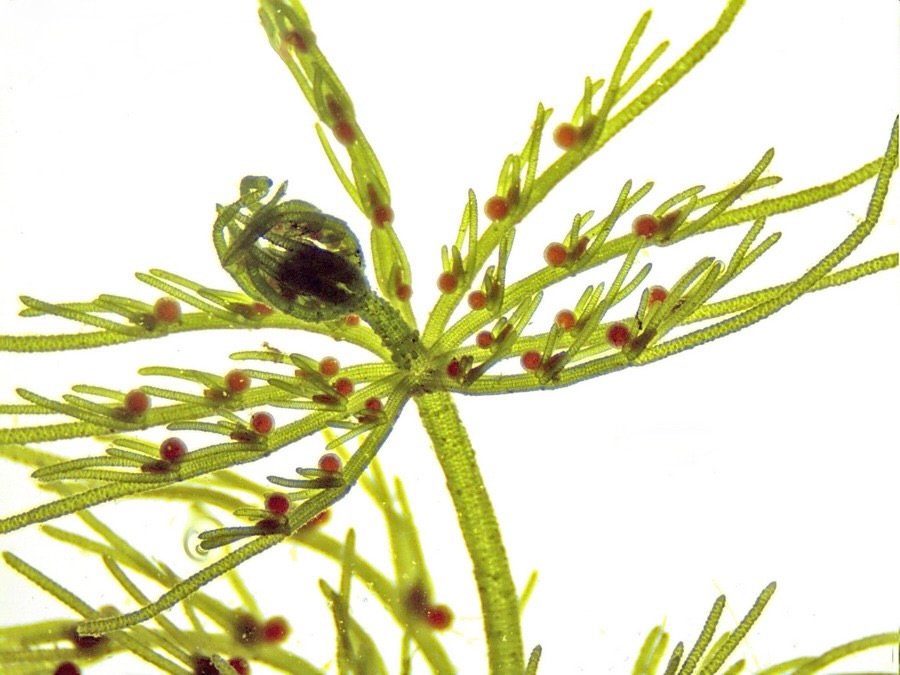
CC Attribution-ShareAlike 4.0 International
.
Chara is also unusual in that it shows no alternation of generations. The one free-living stage is haploid and produces gametes by mitosis. The male gametes swim to the female sex organ to fertilise the egg within. This zygote then undergoes meiosis to produce the typical haploid plant.
Useful Reference Books
Lee, R.E. (2008) Phycology. Cambridge University Press, Cambridge.
Littler, D.S. & Littler, M.M. (2000) Caribbean Reef Plants. OffShore Graphics Inc., Washington.
C.M. Sean Carrington © 2026
All Rights Reserved